A control plane should not execute everything
By Equipo Quantum Developers
Summarize:
The quickest way to ruin a control plane is to turn it into another engine that tries to execute every process. The thesis is testable: an organization needs a control plane when it must apply coherent identity, policy, and evidence across several engines, not when it merely wants to replace execution tools. If the only improvement is moving workflows from one technology to another, the problem was the execution platform, not control.
A useful control plane lets RPA, integrations, agents, scheduled jobs, and specialized software do the work they were chosen for. It centralizes what needs consistency: catalog, identity, permissions, state, approval policy, timelines, artifacts, and analytics.
Control plane does not mean owning every CPU cycle
Kubernetes architecture separates a control plane from worker nodes: the former manages the cluster, while nodes host workloads (Kubernetes architecture). Enterprise automation is not a Kubernetes cluster, so the analogy has limits. It still clarifies a boundary: observing and reconciling state is different from performing each task.
The OpenTelemetry Collector provides a vendor-agnostic way to receive, process, and export telemetry to one or more backends (OpenTelemetry Collector). Its relevant lesson is decoupling. Producers do not have to adopt one backend to share a coherent signal layer. An enterprise control plane should seek the same effect for operational metadata without forcing every engine to become one product.
NIST SP 800-207 separates policy decisions and enforcement through logical components and focuses access on resources, identity, and context (NIST Zero Trust Architecture). This does not make every automation a zero-trust system. It does demonstrate that policy decision, administration, and enforcement are distinct responsibilities that should leave evidence.
What to centralize and what to distribute
Centralize:
- automation, agent, user, and business-object identity;
- catalog, ownership, and lifecycle status;
- minimum permission and approval policies;
- event contracts and exception codes;
- references to artifacts, logs, and timelines;
- health, risk, and outcome indicators;
- evidence of who decided under which version.
Keep in the appropriate engine:
- workflow-native retry and transaction semantics;
- specialized connectors and device controllers;
- domain process logic;
- performance and scaling optimization;
- secrets and credentials where architecture requires;
- compensation that depends on source-system knowledge.
This boundary avoids two bad designs: a passive dashboard that merely copies status, and a monolith that absorbs every integration.
Decision table: build an engine, integrate, or add control
This is an architecture heuristic, not a commercial benchmark:
| Situation | Priority |
|---|---|
| one engine, one team, coherent policy, good evidence | improve the existing engine |
| several engines with comparable states but fragmented visibility | integrate telemetry and catalog |
| several engines with inconsistent approvals and unclear owners | add a control plane |
| unique execution logic, extreme latency, or specialized hardware | build or retain a specialized engine |
| mandatory replacement due to end-of-life or unmitigable risk | migrate the engine, preserving control during transition |
| common policy but data that cannot be centralized | centralize decision and metadata, not content |
Before choosing, ask six questions. How many real engines exist? Who owns each process? Are policies different by design or by accident? Can a decision be reconstructed? What happens when the plane is unavailable? Which data is allowed to move?
A minimum control-plane architecture
A restrained implementation needs:
- Adapters: translate each engine’s status and events without taking over its logic.
- Registry: a catalog with owner, risk, version, and support route.
- Event contract: identity, time, business object, state, evidence, and schema.
- Policy: permission, approval, and action-limit decisions.
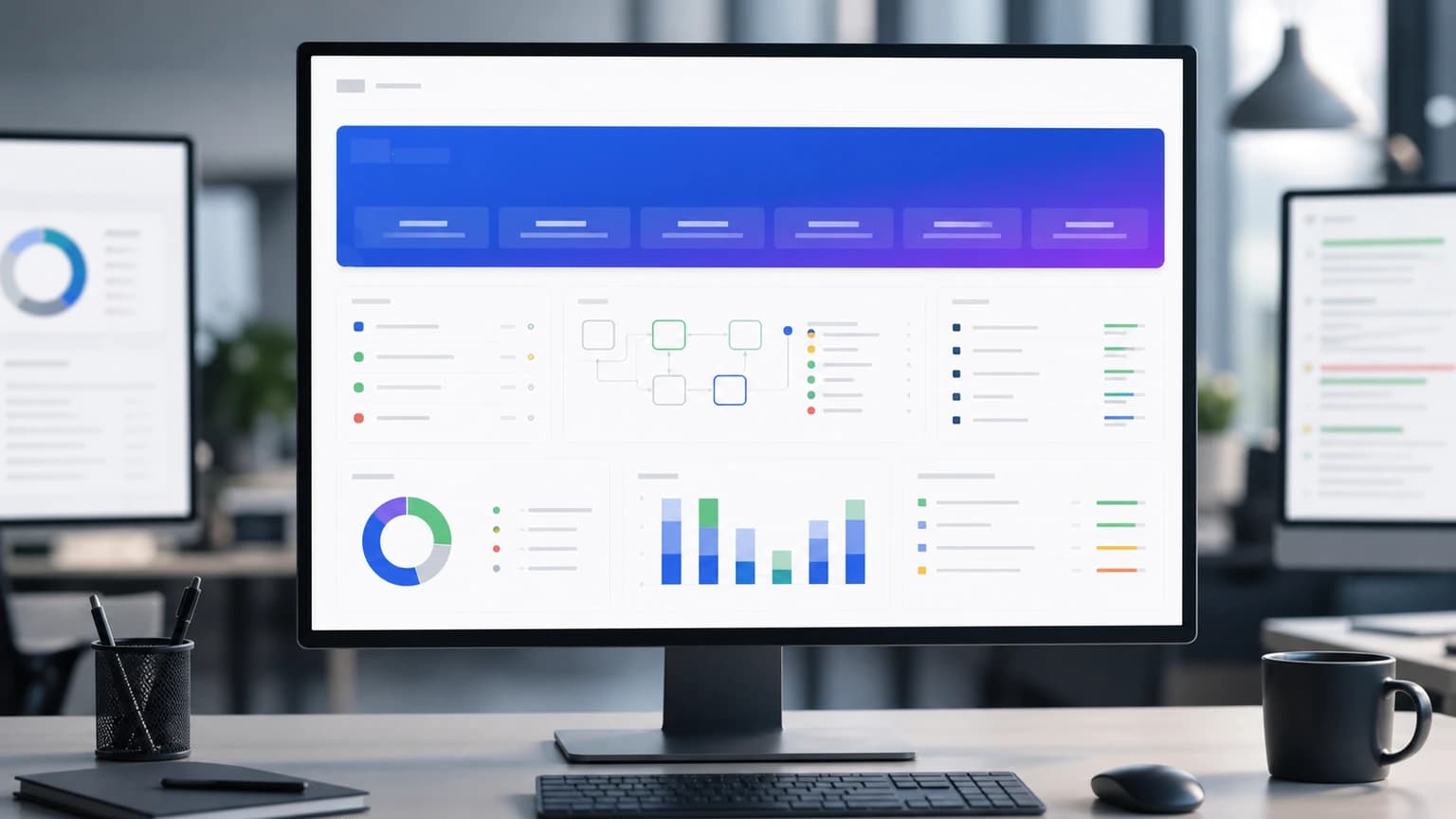
- Operational view: runs, exceptions, timelines, and artifacts.
- Analytics: separate volume, outcome, and risk.
- Degraded mode: engines know what to do when the plane is unavailable.
The last component is decisive. A control plane should not automatically become a single failure that halts every operation. Some actions may continue under cached policy. Others should remain drafts. Irreversible actions may need to stop. That degradation matrix must be tested.
Illustrative architecture
Assume a company has a desktop robot for a legacy portal, an API workflow for its ERP, and an agent that classifies exceptions. Migrating all three into one technology would add cost and could remove useful capabilities. The control plane registers them against a shared invoice object.
The robot emits status and evidence. The workflow validates and writes. The agent proposes a reason code. A central policy requires approval before a beneficiary change and records who granted it. Each engine retains its own retries. The operator sees one timeline without the control plane recreating the portal or ERP transaction. This is an illustrative architecture, not a claim about a customer deployment.
Where Quantum Automation Center fits
The visible surfaces of Quantum Automation Center—catalog, run status, timelines, artifacts, logs, analytics, agents, permissions, and human approval—map to control functions. The decision to adopt it should be based on measured gaps, not a generic “single platform” promise.
A sensible pilot connects two existing engines and one business object. It should prove that an operator can find an exception, reconstruct evidence, and apply one coherent approval. The Automation Center documentation and agent documentation can support evaluation of integration contracts. ROI should come from observed changes in coordination work, incidents, or decision time—not from a number invented before instrumentation.
The counterargument: central layers also fail
An additional layer is another service to deploy, secure, observe, and maintain. A poorly designed global schema can slow teams. A broad policy can erase legitimate differences. A central dashboard can become a stale source. If every change depends on the control-plane team, the organization has built a bottleneck.
Mitigate this with versioned contracts, adapter ownership in domain teams, stable APIs, and local autonomy within boundaries. Measure freshness of the control layer itself and expose when an engine stops reporting.
When not to use a control plane
Do not use one for a single well-governed process or when the existing engine already provides sufficient catalog, permission, evidence, and operations. Avoid it when the organization cannot operate the added layer or when latency requirements make a synchronous dependency unsafe.
The choice is not “centralize everything or have no control.” It is to centralize the decisions and evidence that must be common while leaving execution where it is most reliable. That boundary is what turns a dashboard into a real control plane.